CLX growth: successful experiments moved the numbers
Before the full revamp, we prioritized targeted A/B experiments on the existing product to learn what moved the needle. Two winning experiments guided AI inputs and a performance-tier filter set the direction for what followed.
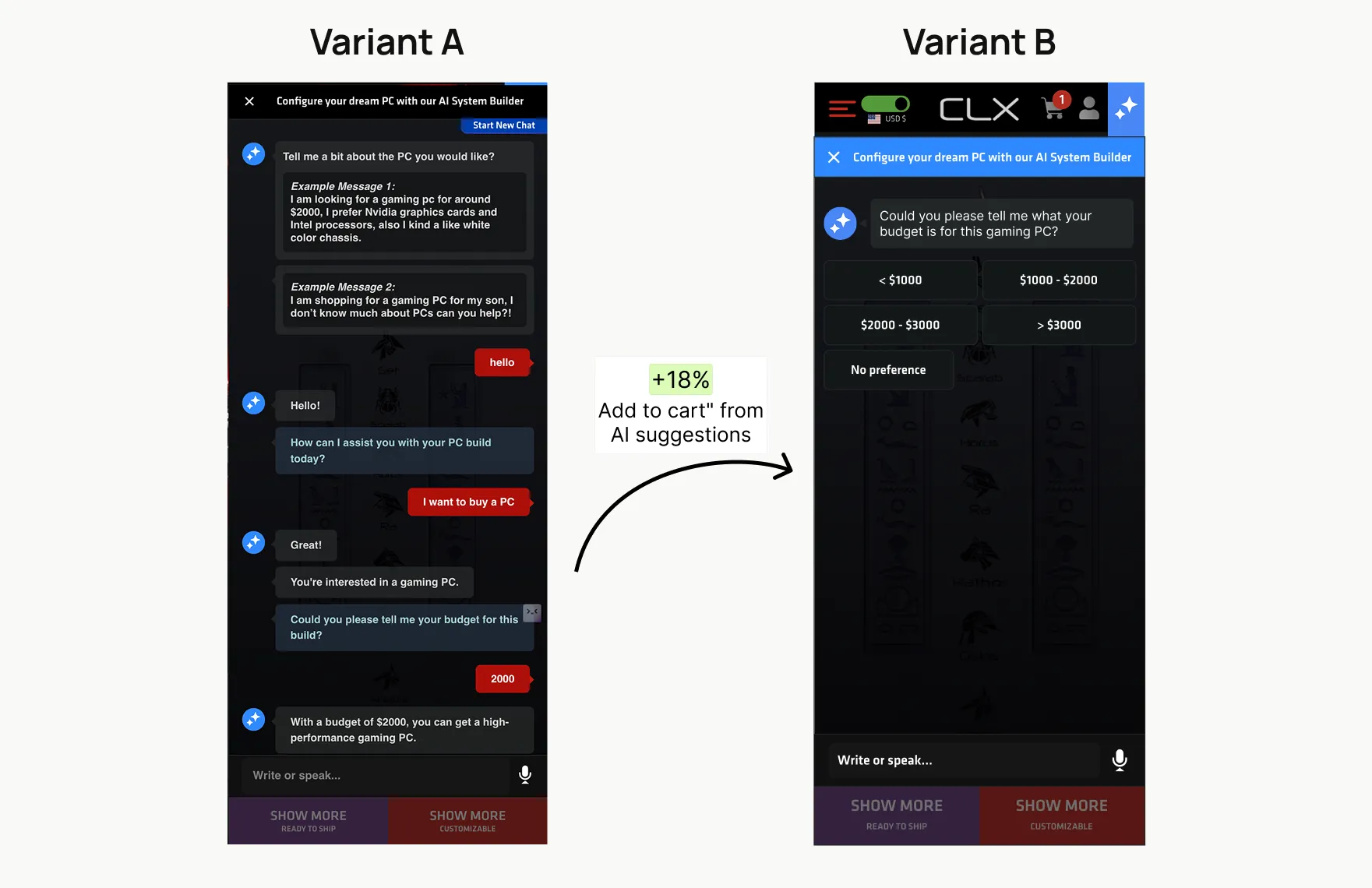
Before the full revamp, the team prioritized targeted A/B experiments on the existing product to learn what moved the needle. Below are two of the winning experiments.
Experiment 01: Guided inputs for the AI System Builder
Context
CLX's AI System Builder lets shoppers describe their dream PC through a chat, budget, GPU brand, CPU brand, use case, and the AI returns a matching build. In the original flow, every question was answered through an open text field.
Problem
Two patterns kept showing up in the data and session reviews:
- Non-technical shoppers didn't know how to phrase answers, especially around GPU and CPU brands.
- Typos and free-form answers confused the LLM, which back then (early 2024) was far less forgiving than today's models. Conversations stalled or returned weak recommendations.
Hypothesis
If we replace open inputs with suggested option chips (budget tiers, brand choices, use cases), users will answer faster, with fewer errors, and reach a recommendation more often — lifting downstream engagement and revenue.
 ### Solution
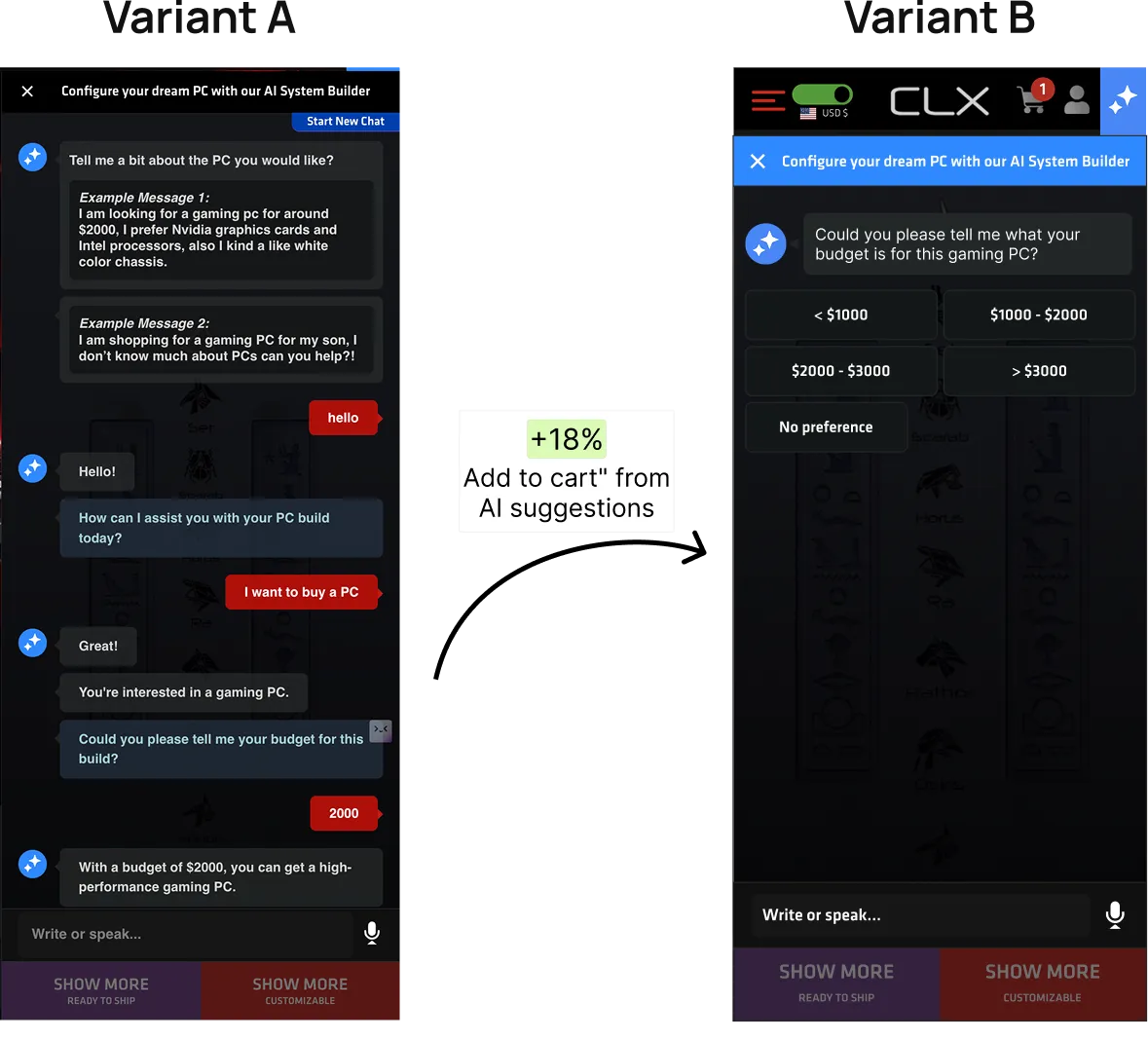
Replaced the open input field with tappable suggestion bubbles under every AI question, so users could pick from a predefined set instead of typing (e.g. Budget: <$1000 · $1000–2000 · $2000–3000 · >$3000 · No preference; CPU brand: Intel · AMD · No preference; GPU brand: NVIDIA · AMD · No preference). Free-text and voice stayed available as a fallback for power users.
Results
A/B test, ~128K users per variant:
- +70% submitted searches
- +48% "Show specs" clicks from AI results
- +31% "Customize" clicks
- +18% "Add to cart" from AI suggestions
- +30% conversion rate of users who opened the AI tool
- +9.7% revenue per AI-tool user (93% chance to win)
💡 The bigger lesson isn't about chips on a chat screen — it's about designing AI conversations for real users. Open input fields assume the user knows what to say. In an AI chat that assumption breaks immediately: the blank field looks flexible, but it transfers all the cognitive load to the user and produces inputs the AI can't reliably act on.
Experiment 02: Performance-tier filter on the product listing
Context
CLX has two main product listings: the RTS listing (Ready-to-Ship, pre-configured PCs) and the Customizable listing (built to order). Both showed a lot of options at once, and the existing filters were component-led — brand, price, individual specs — assuming users already knew which technical attributes mapped to the experience they wanted.
Problem
Session reviews and analytics showed that most shoppers don't browse PCs by spec — they browse by how powerful they need it to be. A kid's first build, a competitive gamer, and a 4K streamer have very different needs, but the old filters made them all translate those needs into clock speeds, GPU model numbers, and RAM tiers. That mental translation was friction: users either filtered aimlessly or didn't filter at all.
Hypothesis
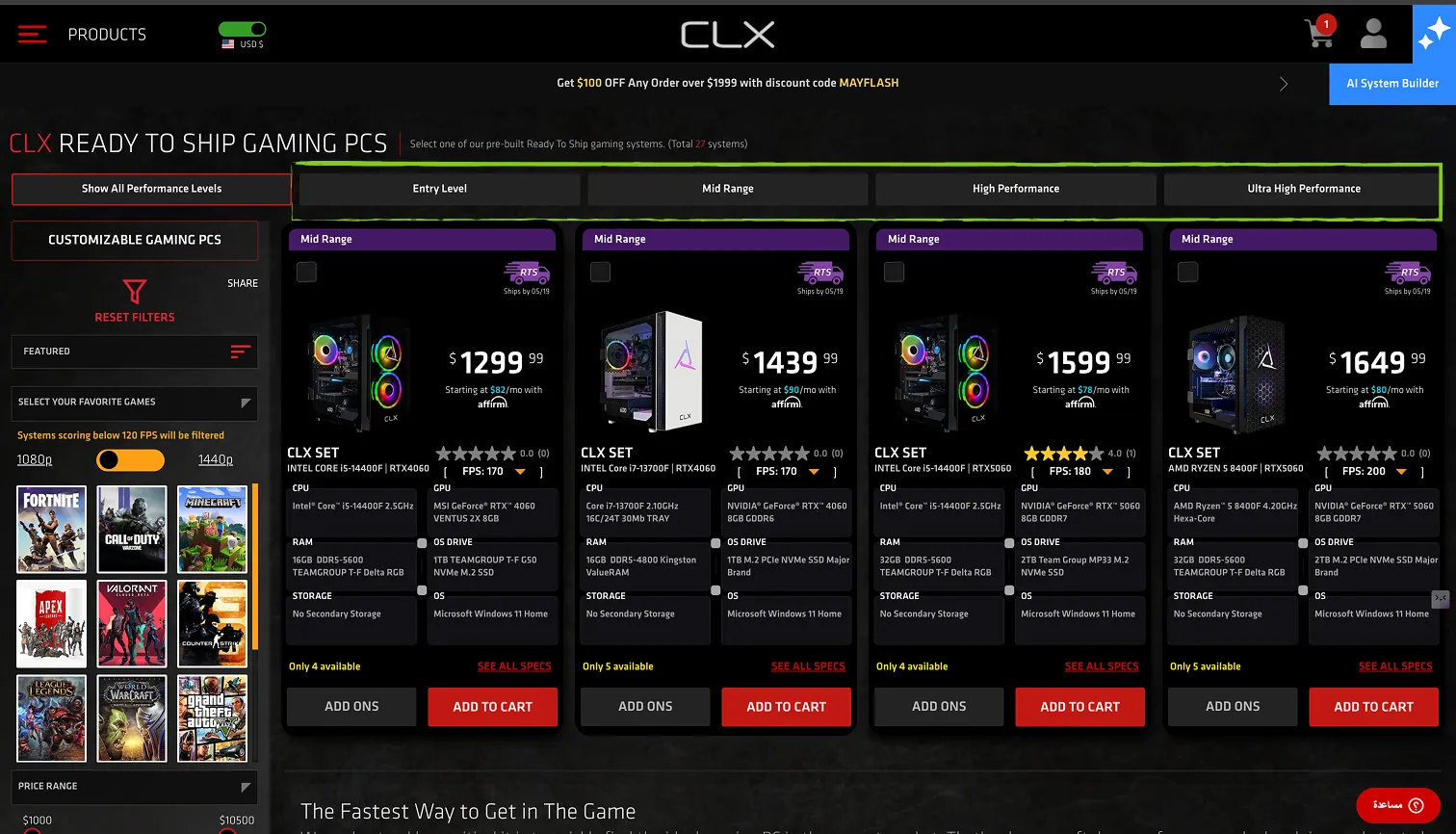
If we replace (or supplement) the spec-led filters with a single performance-tier filter — mapping the catalog to four clear levels (Entry Level, Mid Range, High Performance, Ultra High Performance) — users will reach a relevant subset faster and convert at a higher rate.
Solution
Added a performance-tier filter to both listings, with four tiers anchored in plain language. Each tier maps under the hood to a curated band of CLX systems, so the user picks the experience level they want and the catalog filters down to PCs that deliver it.
Results
RTS listing, primary cohort, 4,647 users:
- +38.96% conversion rate
- +26.62% revenue
- +20.51% revenue per user
- 93.53% chance to win
- 27.8% performance-filter adoption (tiers split fairly evenly)
- "Select any filter" dropped ~19%, not a loss, but a sign the new filter did the job of multiple old filters at once. Users filtered better, not less.
It won decisively on RTS and shipped to 100% of traffic. On the Customizable listing it didn't produce a similar lift
likely because those shoppers are further down the funnel and engage with the configurator instead of relying on filters ,so we kept the RTS rollout and stopped on the customizable side.